
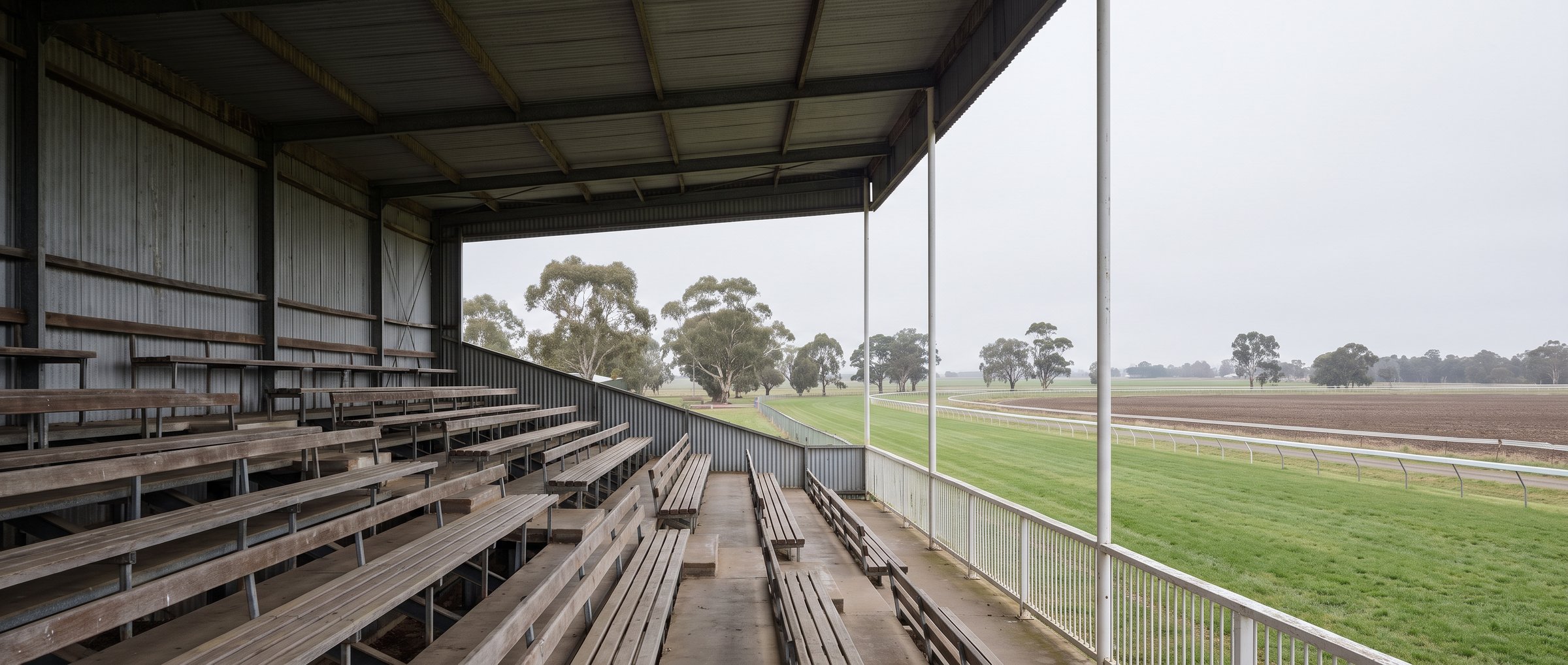
The exterior of a suburban Australian community sports club under an overcast sky

Case studies

Four engagements, with the workings shown

These are real engagements delivered by our group, with Australian clubs and racing organisations. Client names are withheld pending written consent, and meter identifiers and supplier rates are redacted as commercially confidential. Every figure that remains is printed exactly as recorded, in the same form the client's auditor receives it.

01

Three clubs bought gas as one

How aggregating three sites moved them out of small-business pricing.

Sector
Thoroughbred racing clubs
Location
Victoria, Australia
Sites
Three clubs, four gas connections tendered as one
Period
2023 – Q1 2024
Lever
Profile reset
Capital required
None

The situation

Australian wholesale gas prices rose sharply through 2022–23 and further regulatory change to gas pricing was expected. Three clubs under common administration were carrying that increase across four separate gas connections, each priced independently, each on a small-business rate card.

The clubs' own brief was blunt: “to mitigate the sharp rise in gas prices, a strategy was implemented to reset profiles and block future pricing once consumption volume reaches the required threshold.”

The diagnostic

The engagement opened with a single meeting with the club group's chief executive in March 2024, which produced a four-quarter work programme. Before any recommendation, we required every utility and services invoice across the three clubs — the position being that a consumption profile can only be built from raw usage data and billing records, not from a walk-around.

The mechanism

Australian gas retailers price commercial customers in two broad classes. Small-and-medium enterprise customers are sold from a standardised rate card with little room to negotiate. Commercial & Industrial customers are tendered individually — the retailer quotes a bespoke price against that site's actual load profile, and the rate can be fixed for a multi-year term.

Sites above a consumption threshold are eligible for C&I treatment. Many sit on SME rates anyway, for the simple reason that nobody ever asked. Individually, none of these four connections cleared the threshold comfortably. Aggregated into a single tender, they did.

We built a three-year tender bench — the incumbent supplier benchmarked against three competing retailer offers, fixed and variable, over a thirty-six-month term — and re-contracted the clubs on C&I terms.

Class reclassification and tender mechanics are general features of the Australian gas market, described here as background. The engagement records confirm the reclassification and the saving, not the market theory.

Recorded outcome — annual gas cost reduction, by club
SiteActionEnvironmental resultAnnual saving
Turf clubGas SME→C&I quote reviewNo changeA$3,804.43
Racing clubGas SME→C&I quote reviewNo changeA$3,868.13
Racing clubGas SME→C&I quote reviewNo changeA$3,036.72
Total annual cost reductionA$10,709.28
02

A full year, costed and metered line by line

Every intervention carrying a dollar figure, and a tonnage where there is one.

Sector
Returned services (RSL) club
Location
Victoria, Australia
Period
Full year 2023, then Q2 2024
Levers
All three
Capital required
None
Verified abatement
4.56 tCO₂e in 2023

Why this one matters

This is the engagement where the reporting is most complete: five interventions, each carrying a dollar figure and, where applicable, a tonnage taken from a meter rather than a model. The club committed no capital at any point.

Delivered value came to A$9,879.21 alongside 4.56 tCO₂e of verified abatement. One of the five — an electricity re-contracting review — moved against the club by A$7,506.77, and it is printed below with the rest. The ledger you are looking at is the one the client's own auditor receives, with only the redactions noted above.

That is the point of publishing it. Anyone can present four good lines. A ledger you can check is worth more than a case study you can't.

What was actually done

A third-generation LED retrofit and a waste profile reset produced the year's only measured abatement — 1.93 and 2.63 tonnes respectively. Two contract reviews and a metering profile assessment produced cost movement without touching consumption.

The following quarter shifted weight onto resource recovery. Used cooking oil became the single largest line in the programme at A$7,139 a year, by moving the kitchen onto a longer-life fry oil and routing the waste oil to a biodiesel refiner who pays per litre rather than charging for collection.

Recorded outcome — full year 2023
ActionLeverAbatementFinancial result
Gen 3 LED retrofitAsset optimisation1.93 tCO₂eA$993.60
Waste profile resetProfile reset2.63 tCO₂eA$1,636.30
Gas contract reviewProfile resetNo changeA$6,859.31
Electricity metering assessmentProfile resetNo changeA$390.00
Electricity contract reviewProfile resetNo change−A$7,506.77
Verified abatement4.56 tCO₂e—
Delivered valueA$9,879.21
Net financial resultA$2,372.44
Following quarter — Q2 2024 programme
ActionLeverAbatementFinancial result
Fresh & used cooking oilResource recoveryNot quantifiedA$7,139.00
Demand responseAsset optimisationElectricity reductionA$2,875.00
Waste profile resetProfile reset3.39 tCO₂eA$1,989.46
Wax cardboard recoveryResource recovery0.960 tCO₂eA$720.00
Quarter programme valueA$12,723.46
03

Getting paid to switch off for fifteen minutes

Demand response, and why the freezer never notices.

Sector
Clubs and licensed venues
Contract
Automated demand response, five-year term
Interruptions
15 minutes, 6–9 times a year
Installation fee
None
Break fee
None
Capital required
None

The mechanism

Australia's electricity market operator needs headroom on days when demand threatens supply. Rather than firing an expensive peaking plant, it pays aggregators who can guarantee to remove load on command. The aggregator bundles hundreds of small commercial sites into a single controllable block and passes an availability payment down to each one.

The venue nominates which loads may be dropped — cool rooms, freezer rooms, HVAC, a backup generator, light dimming. When an event is called, those loads shut down automatically for fifteen minutes. A cool room holds temperature for far longer than that. A dimming step is imperceptible to a member holding a drink.

Critical zones, gaming areas among them, are carved out of the contract before signature and are never interrupted.

Why it pays

The payment is an availability payment. The venue is paid annually for the capacity it can guarantee, whether or not an event is ever called. Because the operational cost of a fifteen-minute freezer pause is effectively nil, the revenue is close to pure margin.

It is also the rare line in this work that produces a genuine grid-level emissions reduction rather than a purely financial one — the megawatt-hours that would have come from a peaking gas turbine are simply never generated.

Indicative annual rebate

  • Cool rooms, freezer rooms, HVACA$5,000
  • Backup generatorA$3,000
  • Light dimmingA$500
  • Large Victorian site, per yearA$8,500

Figures are the contracted schedule for a large Victorian venue, before a further distributor rebate. A small site schedules at A$1,250. The RSL club in case 02 recorded A$2,875 against this line.

04

The roof that was 60% smaller than the proposal said

Why we climb onto the roof before we quote it.

What happened

A club held two solar proposals for the same building. Both had been designed remotely, from aerial imagery and satellite measurement. One sized the array at 99.75 kW. The other, from a different vendor, sized it at 99.83 kW — near-identical, and comfortably under the 100 kW threshold above which a system faces a heavier compliance and metering regime.

We sent someone onto the roof. Accounting for actual usable area, plant, penetrations, shading and structural capacity, the system the building could genuinely carry was 39.53 kW.

Why it matters

A desktop design that oversizes by a factor of two-and-a-half does not simply fail to deliver. It sets the business case on generation that will never occur, sizes the finance against it, and books abatement that cannot be produced. Every downstream number — payback, tariff offset, tonnes — inherits the error.

If those phantom tonnes were then certified and sold as credits, the error would leave the building and enter the market. This is precisely the failure mode that has damaged confidence in voluntary carbon markets, and it starts with nobody climbing a ladder.

Desktop analysis99.75 kWDesigned from aerial imagery
Desktop analysis99.83 kWSecond vendor, same roof
Physical inspection39.53 kWWhat the roof actually carries

Our standard

Every delivered figure on this page is a recorded outcome. Projections are labelled as projections.

  1. Measured, not modelled

    Abatement is quoted from meter data and engagement records. Where a figure is a projection rather than a delivered result, it is labelled as one.

  2. Our own work only

    We present outcomes our team delivered. A client's own inventory work stays theirs; it never appears in our track record.

  3. Full line items on request

    Under diligence we open the ledger: every intervention, every invoice, every tonne, in the format your auditor prefers.

  4. Client names on consent

    Named references are withheld until each organisation gives written consent. With permission, we introduce you to them directly.

Ask us for the line items.